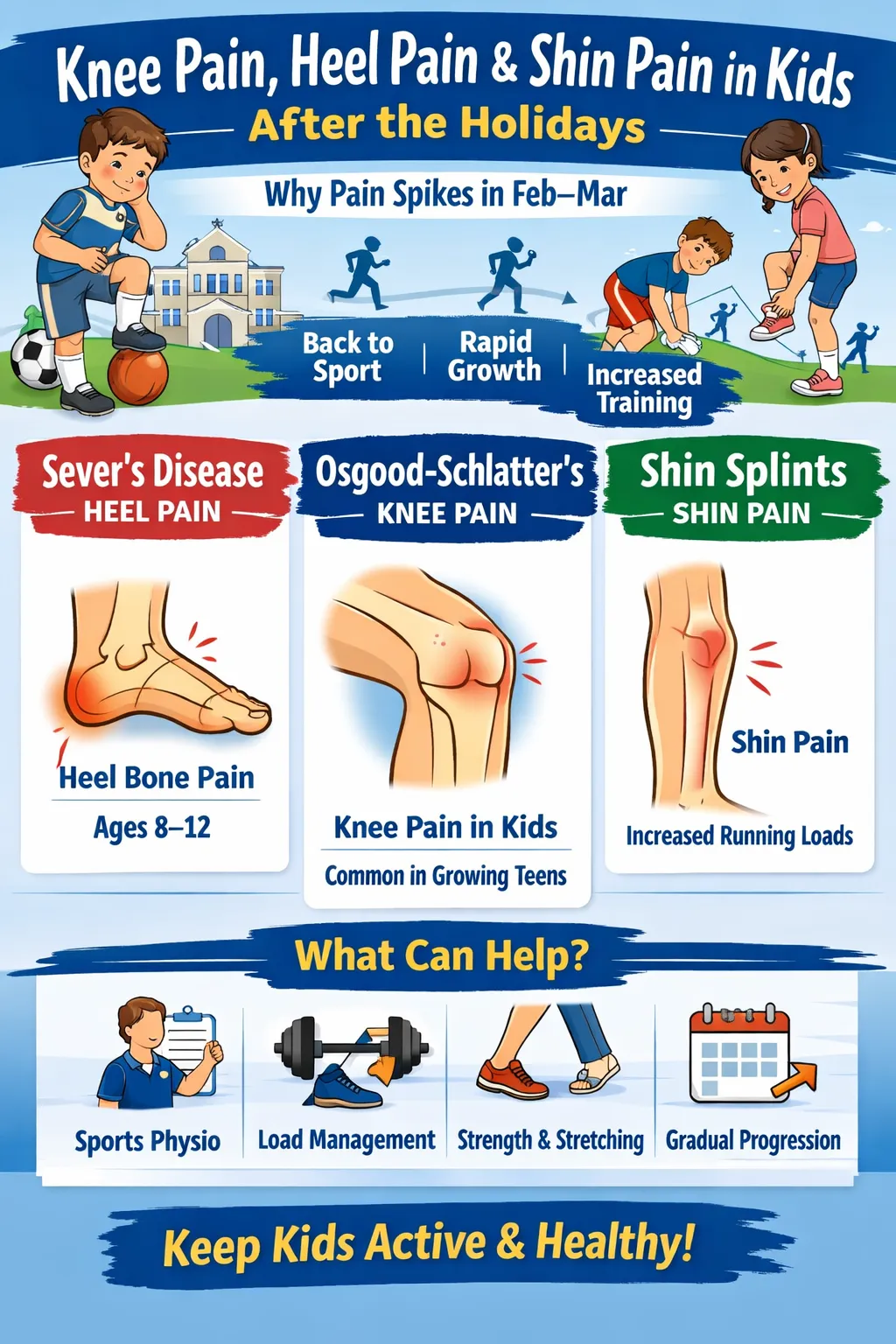
Knee Pain, Heel Pain and Shin Pain in Kids: Why It Spikes After Summer and What Parents Can Do
Every year, like clockwork, we see a surge of kids coming into the clinic in February and March with knee pain, heel pain or shin pain. Parents often tell us the same story.
“They were fine all holidays.”
“They just went back to sport.”
“Training seems to have ramped up all at once.”
If you are hearing complaints of knee pain in kids, heel bone pain in kids, or sore shins after returning to school sport, you are not alone. Three common growth related conditions explain a big chunk of this seasonal spike: Sever’s disease, Osgood-Schlatter’s disease and shin splints.
Let’s break them down and, more importantly, talk about what actually helps.
Why These Injuries Spike in Feb and Mar
During summer holidays, many kids have a break from structured sport. Training loads drop, running volume decreases, and impact exposure is lower.
Then February hits.
Suddenly it is school sport, club training, trials, pre-season camps and sometimes multiple teams at once. Bodies that have not been gradually prepared are asked to do a lot, very quickly.
In growing kids, bones grow faster than muscles and tendons can adapt. That combination of growth plus a rapid jump in training load is the perfect setup for pain.
Sever’s Disease
Heel Bone Pain in Kids
Sever’s disease is one of the most common causes of heel pain in kids aged roughly 8 to 12.
It causes pain at the back or bottom of the heel bone, especially during running and jumping sports like soccer, AFL, netball and basketball. Kids may limp after training or complain that their heels hurt most at the end of the day.
What is happening is irritation of the growth plate at the heel where the Achilles tendon attaches. It is not dangerous and it does not cause long term damage, but it can be very painful.
Management strategies that help
Sports physiotherapy to confirm the diagnosis and rule out other causes
Load management rather than complete rest
Temporary reduction in running and jumping volume
Calf strength and flexibility work
Footwear advice and sometimes heel lifts or orthotics
A gradual return to full training rather than pushing through pain
Osgood-Schlatter’s Disease
Knee Pain in Kids
Osgood-Schlatter’s disease is a very common cause of knee pain in kids and adolescents, particularly during growth spurts.
Pain is felt just below the kneecap at the bony bump on the shin bone. It is often sore to touch and worsens with sprinting, kicking, squatting and jumping.
This condition happens because the tendon pulling on the shin bone is under repeated stress while the bone is still growing.
Management strategies that help
Sports physio assessment to educate kids and parents on what is safe
Modifying training loads rather than stopping all sport
Quadriceps and hip strength work
Managing jumping and sprint volumes
Pain monitoring strategies so kids know when to pull back
Clear communication between parents, coaches and physios
Shin Splints
Shin Pain in Kids and Teenagers
Shin splints cause pain along the inside or front of the lower leg and are common when running loads increase too quickly.
They are often seen in kids who return to pre-season training after a break or who suddenly increase the number of sessions they do each week.
Shin splints are usually a bone stress response rather than a muscle problem.
Management strategies that help
Reducing impact load while keeping kids active
Gradual running progressions
Strength work for calves, feet and hips
Footwear assessment
Early physio input to prevent progression to stress fractures
The Role of Sports Physio and Load Management
One of the biggest myths we hear is that kids just need to stop sport until the pain goes away.
In reality, complete rest often leads to de-conditioning, followed by another flare up when training resumes.
Sports physiotherapy focuses on:
Identifying the exact cause of pain
Educating families on what pain is safe and what is not
Adjusting training loads rather than eliminating them
Building strength to tolerate sport demands
Planning a return to full participation that actually lasts
Load management is the key. It means balancing school sport, club training, games and growth so kids can keep playing without constant pain.
Other Helpful Tips for Parents
Avoid multiple new sports starting at the same time
Build training back gradually after holidays
Encourage kids to speak up early rather than pushing through pain
Remember pain is a signal, not a weakness
Keep an eye out for a growth spurt: it will make these injuries worse
Early assessment usually shortens recovery time
Final Thoughts
If your child has knee pain, heel pain or shin pain after returning to sport, it does not mean they are broken or need to quit playing.
These conditions are common, manageable and very treatable with the right approach.
Early sports physio input and smart load management can keep kids active, confident and enjoying their sport all season.
