Calf Strain Rehab: Recovery, Return to Running and Prevention
Calf strains are one of the most frustrating sports injuries
A calf strain can feel like a small injury at first.
You might feel a grab while running.
You might pull up sore after training.
You might think it is just tightness.
Then you try to run again and it comes straight back.
This is why calf injuries can be so frustrating for runners, footballers, soccer players, netballers, basketballers and field sport athletes.
The calf has to absorb load, produce force and help propel you forward every time you run, sprint, jump or change direction. If it is not properly rehabilitated, it can quickly become a recurring problem.
At Pivot Sports Performance, our sports physiotherapists in Bundoora and sports physiotherapists in Ringwood regularly help runners, footballers and field sport athletes recover from calf strains and return to sport safely.
The goal of calf rehab is not simply to stop pain.
The goal is to rebuild the calf so it can handle running speed, repeated efforts, fatigue, jumping, landing and the demands of your sport.
What is a calf strain?
A calf strain is an injury to one or more of the muscles at the back of the lower leg.
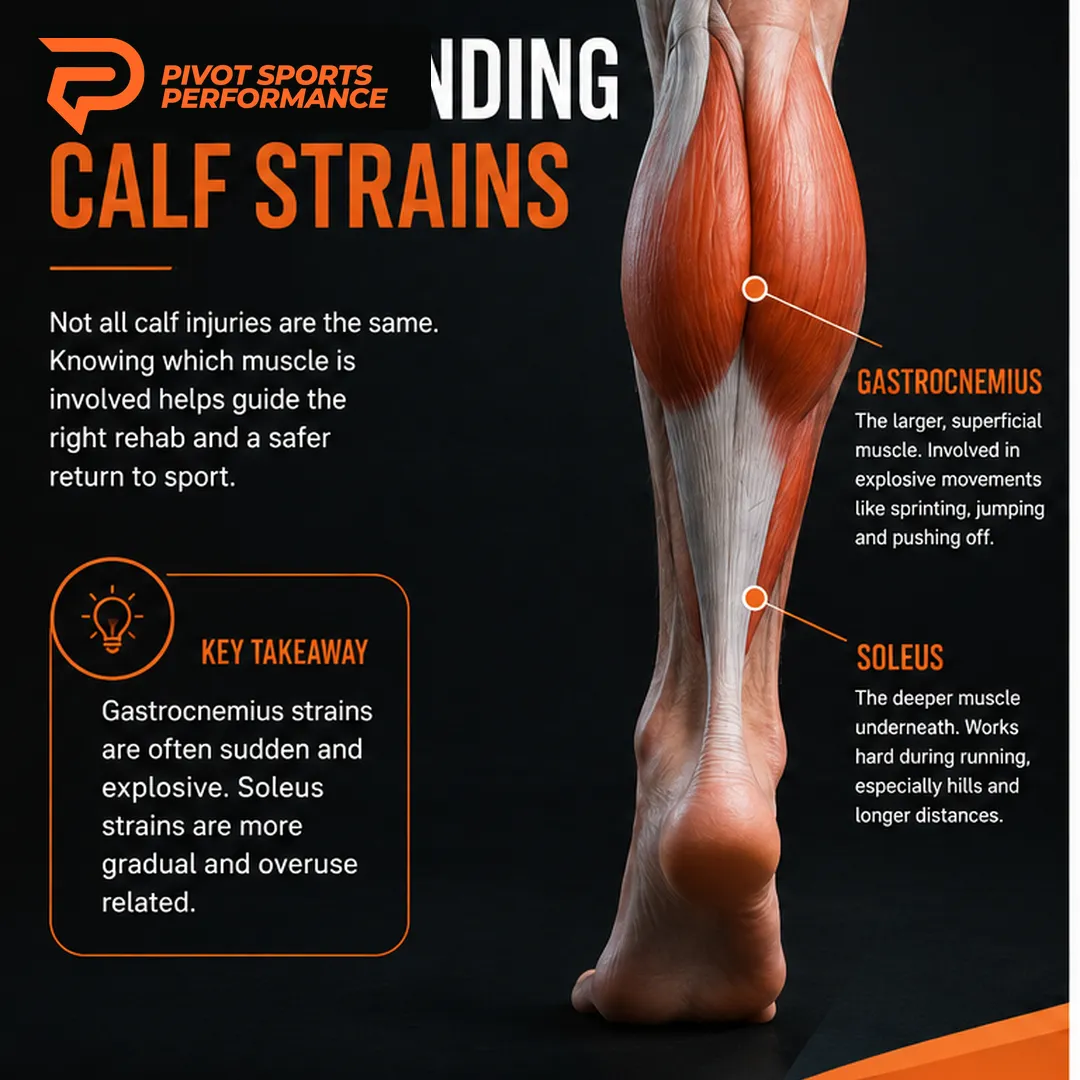
The two main calf muscles are:
Gastrocnemius: the larger, more visible calf muscle
Soleus: the deeper calf muscle that sits underneath the gastrocnemius
Both muscles join into the Achilles tendon and help control your ankle when you walk, run, sprint and jump.
A calf strain happens when the muscle is overloaded beyond what it can tolerate. This may happen suddenly during sprinting or gradually through repeated running load.
Gastrocnemius strain vs soleus strain
Not all calf strains are the same.
This is one of the most important things to understand.
Gastrocnemius strain
A gastrocnemius strain often happens during sudden, explosive movements. This may include:
Sprinting
Jumping
Accelerating
Pushing off
Changing direction
Lunging for a ball
Athletes often describe a sudden sharp pain, pop or grab in the upper calf.
This type of injury is common in field sport athletes because the gastrocnemius crosses both the knee and ankle. It is placed under high stress when the knee is straight and the ankle is forced into dorsiflexion.
Soleus strain
A soleus strain can be more subtle.
It often feels like deep calf tightness or stiffness that builds over time. It may feel okay at the start of a run, then worsen as the session continues.
Soleus injuries are common in runners because the soleus works heavily during distance running, hills, repeated accelerations and longer periods of ground contact.
Common signs of a soleus issue include:
Deep calf ache
Tightness that worsens with running
Pain during hills
Symptoms that build over days or weeks
Pain with bent-knee calf raises
Difficulty tolerating repeated running load
This distinction matters because a runner with a soleus injury may need a different rehab plan to a footballer with a gastrocnemius strain.
Common symptoms of a calf strain
A calf strain may cause:
Sudden pain in the back of the lower leg
A sharp grab during running or jumping
Calf tightness or stiffness
Pain when walking quickly
Pain when pushing off
Pain during calf raises
Bruising or swelling in more significant injuries
Weakness when trying to run, jump or hop
Fear or hesitation when returning to speed
Some calf pain can also come from the Achilles tendon, lower back, nerve irritation, vascular issues or more serious causes such as deep vein thrombosis.
If you have significant swelling, redness, warmth, shortness of breath, unexplained calf pain or symptoms that do not match a normal muscle injury, you should seek medical advice urgently.
How long does a calf strain take to heal?
Recovery time depends on the severity of the injury, the muscle involved and the demands of your sport.
As a general guide:
Mild calf strain: 1 to 3 weeks
Moderate calf strain: 3 to 6 weeks
More significant calf strain: 6 to 12+ weeks
Recurrent calf strain: often longer, especially if strength and running load are not addressed
But time is not the only factor.
A calf can feel fine during walking but still fail when running. It can feel strong in the gym but still be unprepared for repeated sprinting. It can tolerate jogging but not hills, speed or change of direction.
The better question is not:
“How many weeks until I can run?”
The better question is:
“Can my calf handle the exact load I am about to put through it?”
Why calf injuries come back
Calf strains often return because the athlete progresses too quickly from pain-free walking to running, or from jogging to full training.
The calf needs gradual exposure to load.
Common reasons calf strains come back include:
Returning to running before calf strength is restored
Not testing bent-knee and straight-knee calf strength
Ignoring soleus strength
Increasing running volume too quickly
Returning to hills too early
Sprinting before the calf is ready
Poor ankle mobility
Poor foot and ankle strength
Inadequate warm-up
Fatigue
Previous calf injury history
Not completing a proper return-to-running plan
Calf strains often return when athletes skip proper strength progressions, return to speed too quickly or miss the final stages of rehab. This is why our high performance training and sports physiotherapy team work together to rebuild strength, running tolerance and sport-specific capacity.
The calf is a high-load structure. It does not like sudden spikes.
This is why a calf injury often happens when someone returns to sport, increases running, starts preseason, runs hills, adds speed work or plays more minutes than usual.
What should you do in the first few days?
In the early phase, the goal is to settle symptoms and protect the injured tissue while maintaining safe movement.
You should avoid:
Sprinting
Hills
Jumping
Aggressive stretching
Deep massage into the injured area
Testing it repeatedly
Running through sharp pain
Returning to sport because it “feels okay”
Early management may include:
Relative rest
Compression
Gentle pain-free range of motion
Walking within tolerance
Isometric calf loading
Assessment by a sports physio
A clear plan for when to restart strength and running
Complete rest is rarely the answer for mild to moderate calf strains, but the loading needs to match the stage of healing.
Calf strain rehab: what a good plan should include
A good calf rehab plan should be progressive.
It should move from pain control to strength, then to running, then to sport-specific loading.
A complete calf rehab plan should progress from pain control to strength, running, plyometrics and sport-specific speed. For athletes who need a structured pathway, our sports physiotherapy team can guide the full process from injury assessment to return to training.
1. Restore basic calf capacity
Early rehab may include:
Double-leg calf raises
Isometric calf holds
Seated calf raises
Bent-knee calf loading
Straight-knee calf loading
Ankle mobility exercises
Walking progressions
The aim is to restore confidence and basic strength without flaring symptoms.
2. Build gastrocnemius and soleus strength
Both the gastrocnemius and soleus need to be trained.
This means your rehab should include:
Straight-knee calf raises
Bent-knee calf raises
Heavy slow calf strengthening
Single-leg calf raises
Seated calf raises
Tempo-based calf work
Isometric holds
Strength through range
Many athletes only train standing calf raises. This can miss the soleus, which is critical for running.
3. Rebuild running tolerance
Running should return gradually.
A return-to-running plan may include:
Walk-run intervals
Easy flat running
Progressive continuous running
Strides
Controlled accelerations
Higher-speed running
Hills later in the plan
Change of direction later in the plan
For runners, the plan needs to consider distance, pace, hills, shoes, surface and weekly volume.
For footballers and field sport athletes, the plan needs to include acceleration, deceleration, sprint exposure, jumping, cutting and repeated efforts.
If you are dealing with a recurring running injury, calf tightness or repeated setbacks, it is worth having your running load, strength and injury history assessed by a sports physio. You can book a session with our team through our sports physiotherapy booking page.
4. Add plyometrics and elastic strength
The calf acts like a spring during running and jumping.
This means rehab should eventually include elastic loading such as:
Pogos
Skipping
Hopping
Bounds
Jumping
Landing drills
Repeated contacts
Low-level plyometrics progressing to higher intensity
This step is often missed.
If the calf is only trained slowly, it may not be ready for the fast stretch-shortening cycle demands of sport.
5. Return to sport-specific speed
Before returning to full sport, the athlete should be exposed to the demands they will face.
For field sport athletes, this may include:
Acceleration
Deceleration
Curved running
Sprinting
Kicking
Cutting
Jumping
Repeated efforts
Contact or contest work
Training under fatigue
For runners, this may include:
Normal training volume
Tempo running
Hills
Intervals
Race pace
Long runs
Back-to-back sessions where appropriate
You should not return to full sport just because jogging feels fine.
Jogging is not sprinting.
Return-to-sport testing for calf injuries
Calf rehab should include testing before return to sport.
Useful tests may include:
Single-leg calf raise capacity
Bent-knee calf raise strength
Soleus strength testing
Hop testing
Jump testing
Isometric strength testing
Running analysis
Sprint exposure
Change of direction testing
Sport-specific conditioning
Comparison to the opposite side
Testing helps answer a simple question:
Is the calf ready for sport, or does it just feel better?
This is especially important for athletes with recurrent calf strains.
Before returning to full training or competition, athletes should be tested under the types of loads they will actually face in sport. Our return to sport testing helps identify whether an athlete is ready for speed, jumping, change of direction and repeated efforts.
How to reduce the risk of future calf strains
You cannot prevent every calf injury, but you can reduce your risk.
Key strategies include:
Progressive calf strengthening
Soleus-specific strength work
Gradual increases in running load
Regular sprint exposure for field sport athletes
Managing hills and speed work carefully
Good warm-up habits
Monitoring fatigue
Avoiding sudden spikes in training
Maintaining ankle mobility
Completing rehab fully before returning to sport
For runners, the biggest risk often comes from sudden changes in volume, pace, hills or footwear.
For footballers, the risk often comes from spikes in sprint load, preseason fatigue, match minutes or returning to play without enough high-speed exposure.
For footballers, runners and field sport athletes, calf resilience should be part of a broader strength and conditioning plan. Our high performance training program is designed to help athletes build strength, speed, power and injury resilience throughout the season.
Should you stretch a calf strain?
Gentle mobility can be useful, but aggressive stretching early after a calf strain is usually not the answer.
If the muscle has been strained, pulling hard on it may irritate the area and delay progress.
Stretching may be introduced later, but strength and progressive loading are usually more important than simply trying to “loosen” the calf.
If your calf always feels tight, it may not be short.
It may be weak, overloaded or underprepared.
Do you need a scan for a calf strain?
Not always.
Many calf strains can be diagnosed and managed clinically by a sports physio.
However, imaging may be useful if:
There is significant bruising or swelling
You felt a pop
Walking is very painful
Symptoms are not improving
The diagnosis is unclear
There is concern about Achilles involvement
You have recurrent calf injuries
You are an athlete with tight return-to-play timelines
A scan can help identify the location and severity of the injury, but it does not replace good rehab.
Book a calf injury assessment
If you have strained your calf, the worst thing you can do is guess your way back into running.
A good plan should tell you:
What you can do now
What you should avoid
When to restart running
How to progress calf strength
When to add speed
When to return to training
What testing you need before returning to sport
At Pivot Sports Performance, our sports physios work with runners, footballers and field sport athletes to assess calf injuries, rebuild strength and guide a safe return to running and sport.
If your calf keeps tightening, grabbing or breaking down, book a sports physio assessment at Pivot Sports Performance in Bundoora or Ringwood.
You can also book your sports physiotherapy appointment online or contact our team if you are unsure which service is right for you.
Related articles
You may also like:
FAQs
What is the fastest way to heal a calf strain?
The fastest way to recover is to get the loading right. That means protecting the injury early, then progressively rebuilding calf strength, running tolerance and sport-specific capacity. Rest alone is rarely enough.
Can I run with a calf strain?
You should not run through sharp pain or altered movement. Running can usually return once walking, calf loading and basic impact are well tolerated. A structured return-to-running plan is the safest option.
Why does my calf strain keep coming back?
Calf strains often return because the calf has not regained enough strength, soleus capacity, running tolerance or exposure to speed. Returning when pain settles is not the same as being ready for sport.
Is a soleus strain different to a calf strain?
Yes. The soleus is one of the main calf muscles. Soleus strains are often deeper and more gradual than gastrocnemius strains. They are common in runners and can be irritated by hills, distance and repeated running load.
How do I know if my calf strain is serious?
A calf strain may be more serious if you have major bruising, swelling, a pop, difficulty walking, marked weakness or pain near the Achilles. You should also seek urgent medical advice if you have unexplained swelling, redness, warmth or shortness of breath.
Should I massage a calf strain?
Light massage around the area may help symptoms, but aggressive deep tissue massage into a fresh calf strain can irritate the injury. Rehab should focus on progressive loading, not just releasing tightness.
When can I sprint after a calf strain?
Sprinting should only return after you have rebuilt strength, tolerated running progressions and completed lower-level impact work. Sprinting too early is one of the easiest ways to re-injure a calf.
