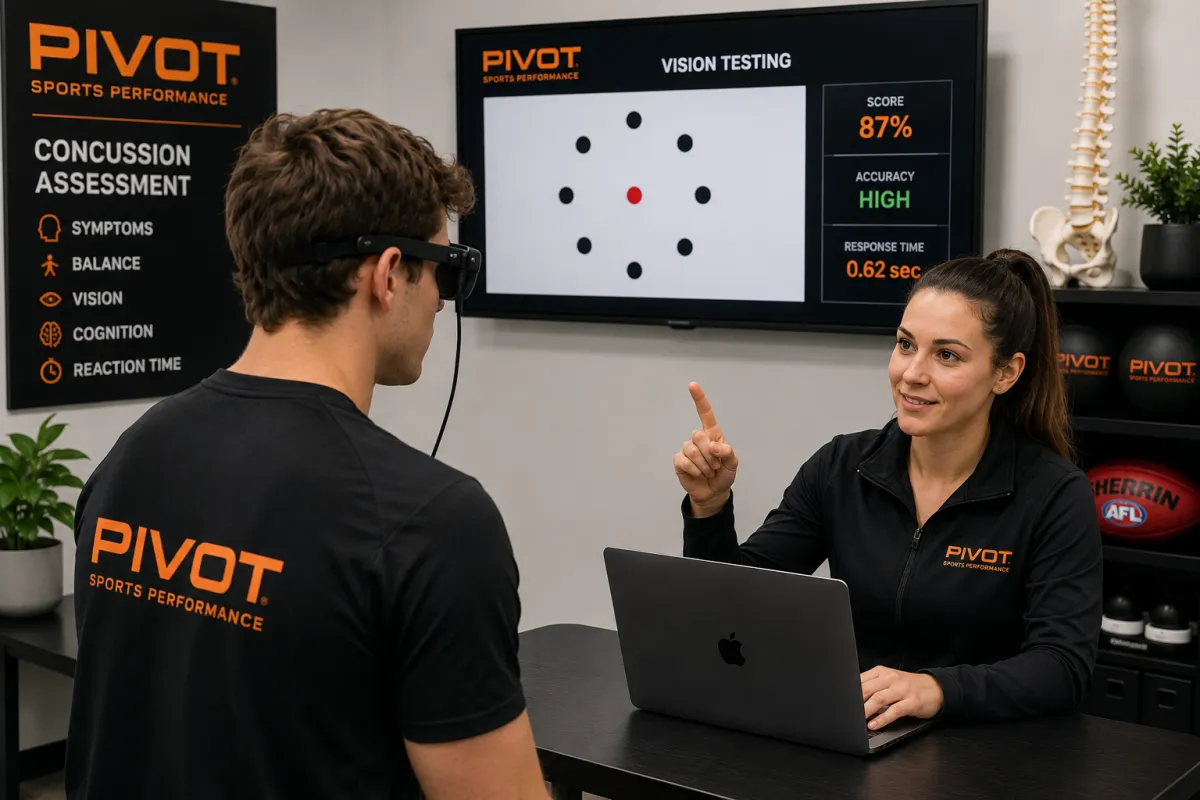
What Does Concussion Baseline Testing Involve? | Pivot Sports Performance
What Does Concussion Baseline Testing Involve?
Concussion baseline testing is a pre-season assessment that measures how an athlete’s brain, body and nervous system function when they are healthy.
The goal is simple.
If an athlete sustains a suspected concussion later in the season, their post-injury results can be compared against their own normal baseline. This can help clinicians make safer, more individual return-to-learn, return-to-work and return-to-sport decisions.
At Pivot Sports Performance, we provide concussion management services through our concussion clinic in Bundoora and Ringwood. This is especially useful for footballers, netballers, basketballers, soccer players, combat athletes, school athletes and anyone involved in contact or collision sport.
What is a concussion baseline test?
A concussion baseline test is a series of assessments completed before a concussion occurs.
It gives the clinician a snapshot of the athlete’s normal function across areas that can be affected by concussion, including:
symptoms
memory
concentration
reaction time
balance
coordination
vision
eye tracking
neck function
neurological function
exertional tolerance
Every athlete is different. Some athletes naturally have excellent balance. Others may have a slower reaction time, a history of migraines, previous concussion, neck pain, visual issues or learning differences.
Without baseline testing, post-concussion results are often compared to population averages. With baseline testing, we can compare the athlete to themselves.
That is the key difference.
Why is concussion baseline testing important?
Concussion can affect each athlete differently.
Two players may receive a similar head knock, but their symptoms, recovery time and return-to-sport pathway may look completely different.
Baseline testing helps clinicians understand what is normal for that individual athlete before injury. This may assist with:
identifying meaningful changes after a suspected concussion
tracking recovery more accurately
guiding return-to-learn and return-to-work decisions
guiding return-to-training and return-to-play decisions
reducing guesswork during concussion management
supporting safer communication between athletes, parents, coaches and health professionals
It is important to understand that baseline testing does not prevent concussion. It also does not replace a proper medical or clinical assessment after a head injury.
Instead, it gives the clinician more information to make better decisions.
If you or your child has already sustained a head knock, you should book a concussion assessment rather than relying on baseline testing alone.
Does baseline testing diagnose concussion?
No single test can definitively diagnose concussion.
Concussion is diagnosed through a clinical assessment that considers the mechanism of injury, symptoms, neurological signs, cognitive changes, balance changes, visual symptoms, neck involvement and the athlete’s overall presentation.
Baseline testing is one part of the bigger picture.
If an athlete suffers a head knock and develops symptoms such as headache, dizziness, fogginess, nausea, light sensitivity, balance problems, blurred vision or difficulty concentrating, they should be removed from play and assessed by an appropriate healthcare professional.
A normal baseline test does not mean an athlete can ignore symptoms.
When in doubt, sit them out.
What does concussion baseline testing involve?
A comprehensive concussion baseline test should assess more than just memory or reaction time.
At Pivot Sports Performance, concussion baseline testing may involve several areas of assessment.
1. Concussion history and risk profile
The first step is understanding the athlete’s history.
This may include:
previous concussions
number of previous concussions
recovery time from previous concussions
history of migraines or headaches
neck injuries
vestibular symptoms
learning difficulties
ADHD
mental health history
sleep issues
sport and playing position
school or work demands
current training load
This information matters because some athletes may be at higher risk of prolonged recovery or may need a more conservative return-to-sport plan if they are injured.
For junior athletes, this section is especially important because school, exams, screen time, sleep and emotional regulation can all influence recovery.
If your child plays contact sport, it is also worth understanding the common concussion symptoms in junior athletes, as children and teenagers do not always describe symptoms clearly.
2. Symptom checklist
The athlete completes a symptom checklist to record how they feel at baseline.
This may include symptoms such as:
headache
pressure in the head
neck pain
dizziness
nausea
blurred vision
balance problems
sensitivity to light
sensitivity to noise
feeling slowed down
fogginess
difficulty concentrating
difficulty remembering
fatigue
confusion
drowsiness
emotional changes
irritability
sadness
nervousness or anxiety
sleep disturbance
Some athletes have symptoms even when they are not concussed. For example, they may commonly experience headaches, neck stiffness, light sensitivity or poor sleep.
Knowing this before injury helps avoid assuming every symptom after a head knock is new.
3. Cognitive testing
Concussion can affect how the brain processes information.
Cognitive testing may assess:
memory
attention
concentration
processing speed
reaction time
learning
decision-making
mental fatigue
This may be completed through written, verbal, app-based or computerised testing.
The purpose is to establish how the athlete performs when healthy, so this can be compared to their post-injury performance if they later sustain a concussion.
For athletes, this is important because sport requires fast decision-making under pressure. A footballer needs to read play, react to contact, process space and make decisions quickly. A netballer needs to track opponents, respond to ball movement and adjust body position at speed.
Concussion can disrupt these abilities, even when the athlete looks normal from the outside.
4. Balance testing
Balance is commonly affected after concussion.
Baseline balance testing may assess:
standing balance
single-leg balance
tandem stance
eyes-open and eyes-closed positions
postural sway
walking balance
dual-task balance
Dual-task testing means the athlete performs a balance or walking task while also completing a thinking task. This is useful because sport rarely involves standing still and thinking about one thing at a time.
Athletes need to move, scan, react and make decisions all at once.
Baseline balance testing gives us a clearer picture of how the athlete performs before injury.
5. Vision and eye movement testing
Concussion can affect the visual system.
Vision and eye movement testing may assess:
smooth pursuit
saccades
convergence
eye tracking
visual motion sensitivity
reading tolerance
screen tolerance
dizziness provoked by eye movement
These tests are important because visual symptoms are common after concussion.
An athlete may report:
difficulty reading
headaches with screens
dizziness in busy environments
trouble tracking the ball
blurred vision
eye strain
difficulty concentrating in class or at work
For students, this can have a major impact on school performance. For athletes, it can affect timing, skill execution and confidence.
6. Vestibular screening
The vestibular system helps control balance, spatial awareness and gaze stability.
Vestibular testing may look at how the athlete responds to:
head movement
eye movement
position changes
balance challenges
busy visual environments
walking while turning the head
Vestibular dysfunction can contribute to dizziness, nausea, motion sensitivity and feeling “off” after concussion.
Having a baseline can help the clinician understand whether post-injury dizziness or balance problems are new, significant and improving over time.
7. Neck assessment
The neck is often involved in concussion injuries.
A head knock, tackle, fall or collision can place force through the cervical spine. Sometimes symptoms such as headache, dizziness, pressure in the head or visual discomfort may be influenced by the neck.
A baseline neck assessment may include:
range of motion
neck strength
joint tenderness
muscle tenderness
headache referral
upper cervical control
previous neck injury history
This is especially relevant in contact sports such as AFL, rugby, soccer, basketball, netball and combat sports.
At Pivot, our sports physiotherapy team regularly assesses both the concussion and the surrounding physical contributors, including the neck, vestibular system and visual system.
8. Neurological screening
A neurological screen helps check the function of the nervous system.
This may include assessment of:
cranial nerves
eye movement
facial sensation
facial movement
limb strength
reflexes
sensation
coordination
balance
walking pattern
pronator drift
upper limb neurological signs
lower limb neurological signs
This does not replace urgent medical care when red flags are present.
If an athlete has worsening symptoms, repeated vomiting, seizure, loss of consciousness, increasing confusion, weakness, severe neck pain, unusual behaviour or deteriorating alertness, urgent medical assessment is required.
9. Reaction time and coordination
Sport is fast.
An athlete needs to react to opponents, teammates, ball movement, contact and space. Concussion may affect reaction time and coordination, even when the athlete feels mostly normal.
Baseline testing may include tasks that assess:
simple reaction time
choice reaction time
hand-eye coordination
movement accuracy
dual-task performance
sport-relevant decision-making
This information can be useful when deciding whether an athlete is ready to progress from controlled exercise to more complex training.
10. Exercise tolerance and return-to-sport planning
Some baseline assessments may also consider exercise tolerance or previous training capacity.
After concussion, athletes often need to progress through a graded return-to-sport plan. This may include:
symptom-limited activity
light aerobic exercise
moderate exercise
high-intensity exercise
non-contact training
controlled contact
full contact training
return to match play
Baseline testing helps provide context for what the athlete normally tolerates and what level they need to return to.
Footballers should also follow a structured AFL concussion return to play protocol before returning to contact training or match play.
At Pivot, this is where our integrated model is valuable. We combine concussion management, sports physiotherapy, strength and conditioning, rehabilitation and performance testing under one roof.
For athletes who need ongoing physical preparation after injury, our Athlete Performance Program can help bridge the gap between rehab, training and performance.
How long does concussion baseline testing take?
The time required depends on the level of testing being completed.
A simple computerised screen may take around 20 minutes. A more comprehensive multimodal baseline test may take longer because it assesses symptoms, cognition, balance, vision, vestibular function, neck function and neurological signs.
For athletes in contact or collision sport, a more complete assessment is usually more useful than relying on one test alone.
Who should get concussion baseline testing?
Concussion baseline testing is useful for athletes who participate in sports where head impacts, falls, tackles, collisions or accidental contact can occur.
This includes:
AFL footballers
rugby players
soccer players
basketballers
netballers
hockey players
combat sport athletes
cyclists
skiers and snowboarders
gymnasts
school athletes
junior representative athletes
athletes with a previous concussion history
It is particularly useful for athletes who have had previous concussions, prolonged symptoms, high academic demands, high training loads or are preparing for a competitive season.
When should baseline testing be done?
The best time to complete baseline testing is before the season starts.
For most athletes, this means pre-season.
Baseline testing should ideally be completed when the athlete is healthy, well-rested and not currently experiencing concussion symptoms.
It may also be repeated yearly, especially for growing junior athletes or athletes in high-risk sports.
What happens if I get concussed after baseline testing?
If you sustain a suspected concussion, your baseline results can be used as part of your post-injury assessment.
Your clinician may compare your current results with your baseline across areas such as symptoms, balance, reaction time, visual function and cognition.
This helps answer questions such as:
Has the athlete returned to their normal level?
Are symptoms still present under cognitive load?
Does balance remain affected?
Does vision or eye tracking remain impaired?
Is the athlete tolerating school, work and exercise?
Are they ready to progress training?
Do they need more rehab before returning to contact?
Return-to-sport should not be based on one result alone. It should be based on the athlete’s full clinical picture.
If you are unsure whether you or your child is ready to return to sport, read our guide on when you can return to sport after concussion or book an appointment with our concussion team.
Is concussion baseline testing only for elite athletes?
No.
Baseline testing is not just for professional athletes.
In fact, it can be extremely valuable for junior and community athletes because they often do not have the same level of medical support available on game day.
For parents, baseline testing provides useful information before the season starts. If their child sustains a concussion, there is a clearer reference point to help guide recovery and return-to-play decisions.
This can reduce uncertainty and help avoid rushed decisions.
Why choose Pivot for concussion baseline testing?
Pivot Sports Performance provides concussion management services in Bundoora and Ringwood for athletes, parents, clubs and schools.
Our model is built around sports physiotherapy, strength and conditioning, performance testing and concussion care. That means we can help athletes move from assessment to rehabilitation, exercise progression and return-to-sport planning.
Our concussion management services may include:
baseline concussion testing
post-concussion assessment
symptom monitoring
vestibular rehabilitation
neck assessment and treatment
graded return-to-exercise planning
return-to-learn support
return-to-work support
return-to-training planning
return-to-play guidance
If you are an athlete, parent, coach or club looking for concussion baseline testing in Melbourne, you can book a concussion assessment through our Bundoora or Ringwood concussion clinic.
Book concussion baseline testing in Bundoora or Ringwood
Concussion baseline testing gives athletes, parents and clubs a clearer starting point before the season begins.
It does not prevent concussion.
It does not replace clinical judgement.
But it does provide valuable information that can help guide safer decisions if a concussion occurs.
If you want to organise concussion baseline testing for yourself, your child, your team or your club, book a concussion assessment at Pivot Sports Performance.
We provide concussion baseline testing and concussion management at our Bundoora and Ringwood facilities.
Frequently Asked Questions
What does concussion baseline testing involve?
Concussion baseline testing usually involves a combination of symptom reporting, cognitive testing, balance testing, vision testing, vestibular screening, neck assessment, neurological screening and reaction time testing. The aim is to measure an athlete’s normal function before injury.
Does a baseline test diagnose concussion?
No. A baseline test does not diagnose concussion by itself. Concussion is diagnosed through a clinical assessment. Baseline results can help clinicians compare post-injury function to the athlete’s normal pre-injury function.
How often should athletes complete baseline testing?
Many athletes complete baseline testing before each season. For junior athletes, yearly testing can be useful because the brain, body and sporting demands change as they grow.
Is baseline testing useful for junior athletes?
Yes. Baseline testing can be useful for junior athletes, especially those playing contact or collision sports. It gives parents, clinicians and clubs more information if the athlete later sustains a suspected concussion.
Can I play if my baseline test is normal after a head knock?
Not automatically. If you have symptoms after a head knock, you should not return to play on the same day. A normal test result does not override symptoms or clinical concern.
Where can I get concussion baseline testing in Melbourne?
Pivot Sports Performance provides concussion baseline testing and concussion management in Bundoora and Ringwood. You can book a concussion assessment through our concussion clinic.
