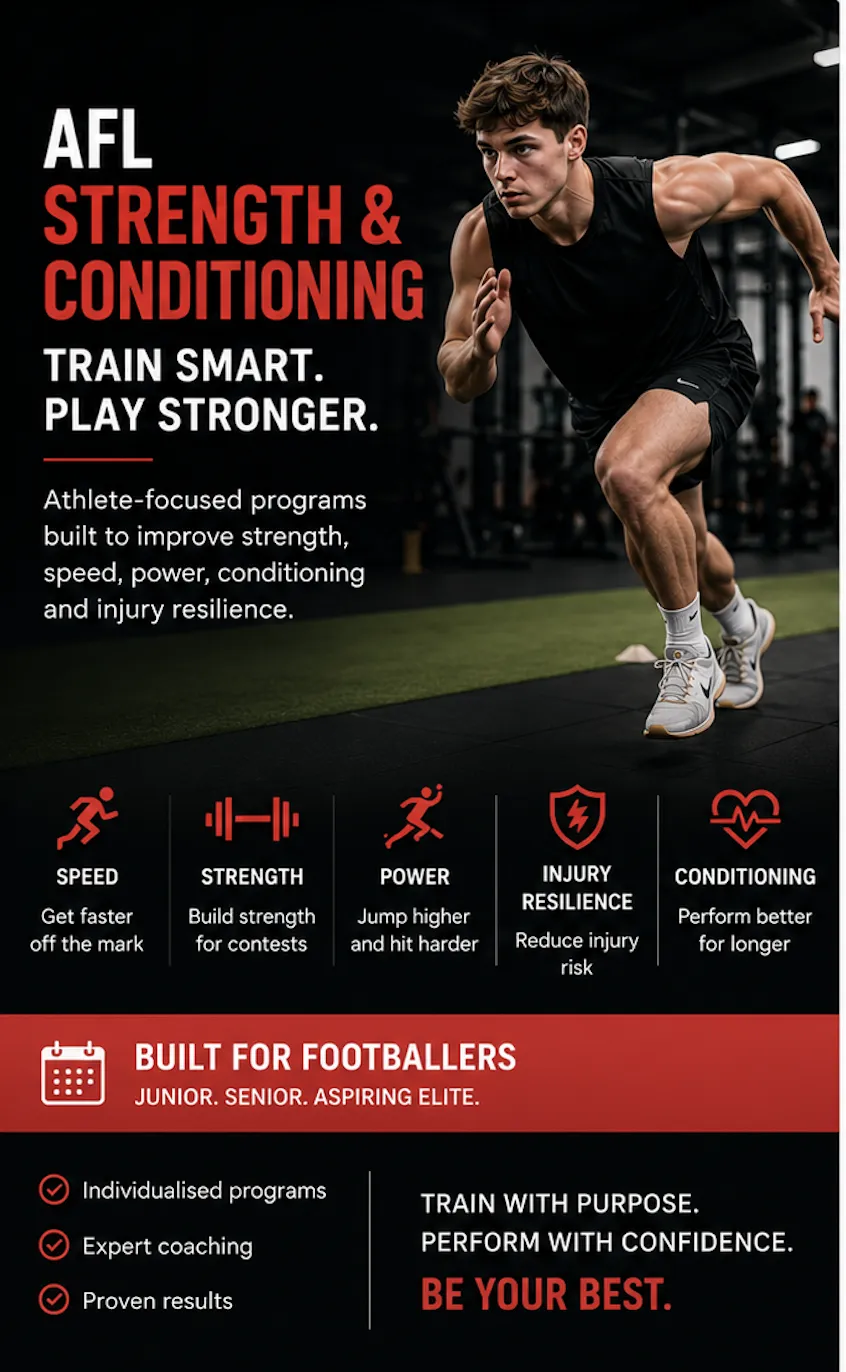
Improve AFL Performance With Strength and Conditioning | Pivot Sports Performance
How Strength and Conditioning Improves AFL Performance
AFL is one of the most demanding sports in Australia.
It is not just running. It is not just kicking. It is not just being strong in the gym.
A good AFL player needs to sprint, jump, change direction, tackle, absorb contact, repeat high-speed efforts, recover quickly, and still make good decisions late in the game when fatigue is high.
That is why strength and conditioning is such an important part of AFL performance.
For junior footballers, local footballers, VFL-level athletes, and aspiring elite players, the gym should not be seen as something separate from footy. It should be viewed as one of the tools that helps a player become faster, stronger, more durable, and more confident on the field.
At Pivot Sports Performance, we work with athletes who want to improve their performance, reduce injury risk, and build a body that can handle the demands of football.
Why AFL Players Need Strength and Conditioning
AFL is a repeat-effort sport.
Players need to sprint, jog, walk, accelerate, decelerate, jump, tackle, wrestle, kick, mark, and change direction across four quarters. The challenge is not just doing one fast sprint or one strong tackle. The challenge is being able to repeat those efforts again and again.
Research into Australian football has shown that players are exposed to repeated high-speed running, changes in intensity, and large physical demands across a match. You can read more about match running demands in Australian football through research published in the Journal of Science and Medicine in Sport.
This is where strength and conditioning can make a major difference.
A well-designed AFL strength and conditioning program can help improve:
Acceleration
Sprint speed
Change of direction
Jumping and marking power
Tackling strength
Contact tolerance
Running efficiency
Repeat sprint ability
Injury resilience
Confidence in contests
The best footballers are not always the athletes who look the best in the gym. They are the athletes who can transfer their strength, speed, and power onto the field.
That transfer is the key.
Strength Training Helps AFL Players Win More Contests
Strength is one of the foundations of AFL performance.
A stronger athlete will often be better prepared to hold their position in a contest, break tackles, stick tackles, absorb body contact, and maintain control when under pressure.
For AFL players, strength training should usually include lower body, upper body, trunk, and single-leg work.
Important strength qualities for footballers include:
Single-leg strength for sprinting, kicking, and changing direction
Posterior chain strength for hamstrings, glutes, and hip power
Trunk strength for tackling, contact, and balance
Upper body strength for marking contests and grappling
Calf and ankle strength for running, jumping, and landing
Exercises like squats, split squats, deadlifts, hip thrusts, calf raises, rows, presses, carries, and hamstring strength work can all play a role.
At Pivot Sports Performance, we use this type of approach through our High Performance Training program, which is built for athletes who want to improve strength, conditioning, speed, power, and injury resilience.
If you want to understand why lower body strength matters so much for footballers, you can also read our blog on lower body strength for football performance.
But the program must match the athlete.
A 14-year-old junior footballer does not need the same program as a senior footballer. A player returning from a hamstring injury does not need the same program as a player trying to build pre-season running capacity. A midfielder does not always need the same focus as a key position player.
Good strength and conditioning is specific.
Speed Is Built, Not Just Born
Many players think speed is something you either have or do not have.
That is not true.
Some athletes may naturally be faster, but speed can still be trained. In AFL, speed is about much more than running a fast 100 metres. Players need to accelerate quickly, react to the ball, create separation from an opponent, close space defensively, and repeat fast efforts under fatigue.
A good AFL speed program should include:
Acceleration training
Sprint mechanics
Max velocity exposure
Change of direction training
Deceleration training
Plyometrics
Strength training to support force production
Many AFL players spend a lot of time running laps, but not enough time learning how to sprint properly.
This matters because AFL games are often decided by short bursts. A player who gets to the ball half a step earlier can win possession. A defender who closes space faster can spoil. A forward who creates separation quicker can mark inside 50.
Speed changes games.
For athletes who want to improve this area, our Speed and Agility Training is designed specifically for team-sport athletes who need to accelerate, evade, decelerate, and change direction under pressure.
You can also read our blog on sprint training for athletes to learn why sprinting should be treated as a skill, not just a fitness drill.
Power Helps With Jumping, Sprinting, Kicking, and Contact
Power is the ability to produce force quickly.
In AFL, power shows up when a player jumps for a mark, accelerates from a stoppage, changes direction, kicks with distance, or drives through a tackle.
Power training can include:
Jump training
Medicine ball throws
Olympic lift variations
Sled pushes or pulls
Sprint training
Plyometrics
Loaded jumps
Power training should be progressed carefully. Athletes need enough strength and movement control before they complete high-level explosive work.
For younger athletes, this might begin with landing mechanics, skipping, hopping, jumping, and basic medicine ball throws. For more advanced athletes, the program may include heavier and faster movements.
The goal is not to make the gym session look impressive. The goal is to help the athlete move better on the field.
Conditioning Needs To Match The Demands Of AFL
AFL conditioning is often misunderstood.
Many footballers think they just need to run more. While running fitness is important, AFL players need more than general endurance.
They need the ability to handle repeated high-speed efforts, recover between contests, and keep performing late in quarters.
A good AFL conditioning plan may include:
Aerobic conditioning
Tempo running
Repeat sprint training
High-speed running exposure
Change of direction conditioning
Football-specific conditioning drills
Position-specific running demands
Research on peak running demands in Australian football shows that the most intense periods of play can be far higher than average match demands. This means players need to be prepared for the hardest parts of the game, not just the average demands. You can read more on this through Australian football running demands research in the Journal of Science and Medicine in Sport.
For example, a midfielder may need more repeat running capacity. A key forward may need more repeated leading patterns, acceleration, and contest repeatability. A defender may need to sprint, decelerate, change direction, and re-accelerate many times in response to their opponent.
The best conditioning plan is not random. It should prepare the athlete for the way they actually play.
If you want to understand why pre-season preparation matters, read our blog on early-season training for athletes.
Injury Prevention Is A Performance Strategy
In AFL, availability matters.
A player cannot improve if they are constantly missing training and games. That is why injury prevention should not be seen as boring or separate from performance. It is part of performance.
Common AFL injury areas include:
Hamstrings
Groins
Calves
Ankles
Knees
Shoulders
Lower back
Strength and conditioning can help reduce injury risk by improving the athlete’s ability to tolerate the demands of football.
This may include:
Hamstring strength training
Hip and groin strengthening
Calf and Achilles capacity work
Landing and change of direction mechanics
Single-leg control
Trunk strength
Progressive sprint exposure
Load management
Recovery planning
The Australian Institute of Sport provides resources on athlete health, performance, load, recovery, and injury prevention. Sports Medicine Australia also provides useful guidance on sports injury prevention.
For footballers recovering from injury, our Sports Physiotherapy Bundoora and Sports Physiotherapy Ringwood services are designed to integrate injury management with performance-based rehab.
This is important because footy players do not just need to become pain-free. They need to return to sprinting, tackling, jumping, cutting, kicking, and competing.
A strong athlete is not automatically injury-proof. But a well-prepared athlete usually has more tools to handle the speed, contact, and fatigue of AFL.
ACL, Hamstring, and Lower Limb Strength Matter In AFL
AFL places huge demand on the lower body.
Sprinting, jumping, landing, tackling, cutting, and kicking all require strength and control through the hips, knees, ankles, and trunk.
For footballers recovering from knee injuries, an integrated rehab model is essential. You can learn more through our ACL Rehabilitation Bundoora and ACL Rehabilitation Ringwood pages.
We have also written about why ACL rehabilitation and knee physio need integrated strength and conditioning.
Hamstring strength is also critical for AFL players because of the high-speed running demands of the sport. Sprinting places large loads through the hamstrings, which means footballers need more than stretching and massage. They need progressive strength, sprint exposure, and smart load management.
For players dealing with knee injuries beyond ACL injuries, our guide on PCL injury rehab for athletes may also be useful.
Testing Helps AFL Players Train With Purpose
One of the biggest mistakes athletes make is guessing.
They guess what they need. They guess what their weaknesses are. They guess if they are improving.
Performance testing helps remove the guesswork.
At Pivot Sports Performance, testing can help identify areas such as:
Strength levels
Power output
Jump performance
Sprint ability
Change of direction ability
Asymmetries
Movement control
Return-to-sport readiness
Conditioning capacity
Testing gives the athlete and coach a clear starting point.
For example, one athlete may need more hamstring strength. Another may need better acceleration mechanics. Another may need improved change of direction control. Another may need more high-speed running exposure before they are ready for game demands.
When athletes test, train, and re-test, they can see progress clearly.
That builds confidence.
If you are ready to train with more purpose, you can book a Strength and Conditioning session or speak with our team through our contact page.
Strength and Conditioning For Junior AFL Players
Junior AFL players should not just copy adult gym programs.
Young athletes need coaching, structure, and appropriate progressions. The goal is to build long-term athletic development, not rush them into heavy lifting before they are ready.
A good junior AFL strength and conditioning program should focus on:
Movement quality
Bodyweight strength
Landing mechanics
Coordination
Sprint technique
Jumping and hopping skills
Basic gym technique
Confidence in training
Safe progression over time
The National Strength and Conditioning Association has published position statements supporting appropriately supervised youth resistance training. You can read more on youth resistance training through this open-access review on PubMed Central.
For parents wondering when their child should start, we have also written a blog on when kids should start strength training.
For many junior footballers, strength and conditioning is not just about getting stronger. It helps them learn how to move, train, recover, and take ownership of their development.
This is especially important for athletes who want to play higher-level football in the future.
What AFL Players Should Train In-Season
In-season training should not stop.
The goal changes.
During pre-season, athletes may focus on building strength, speed, power, and running capacity. During the season, the goal is often to maintain key qualities, manage fatigue, and stay available.
An in-season AFL gym program may include:
Lower volume strength work
Power maintenance
Hamstring, groin, calf, and trunk work
Mobility where needed
Recovery-focused sessions
Individual injury prevention exercises
Short speed exposures when appropriate
The biggest mistake is doing nothing in-season.
When players stop strength training during the season, they can lose the physical qualities they built during pre-season. This may impact performance and increase the risk of feeling underprepared as the season goes on.
In-season training does not need to be huge. It needs to be smart.
What AFL Players Should Train In The Off-Season
The off-season is a great time to build.
This is when players can target weaknesses without the same pressure of weekly games. Depending on the athlete, this may include building muscle, improving strength, developing speed, addressing old injuries, improving running mechanics, or preparing for a strong pre-season.
A good AFL off-season plan may include:
Strength development
Hypertrophy where needed
Sprint mechanics
Speed exposure
Movement quality
Mobility if restricted
Injury rehabilitation
Gradual conditioning
Testing and goal setting
The off-season should not be random.
It is a chance to build the body before the next season starts.
If you want a more detailed look at this, read our blog on AFL off-season strength training.
How Pivot Sports Performance Helps AFL Players Improve
At Pivot Sports Performance, we help AFL players train with a clear plan.
Our approach combines sports physiotherapy, strength and conditioning, performance testing, and return-to-sport planning. This means athletes are not just doing random exercises. They are following a program that matches their body, sport, goals, injury history, and playing demands.
You can learn more about our team and approach on our About Pivot page.
We help AFL players who want to:
Get faster
Build strength
Improve power
Jump higher
Change direction better
Reduce injury risk
Return from injury
Prepare for pre-season
Build confidence in their body
Perform better on game day
We work with athletes across Bundoora, Ringwood, and surrounding Melbourne suburbs.
Whether you are a junior footballer, local senior player, aspiring VFL athlete, or parent looking for the right support for your child, strength and conditioning can be a major part of your development.
You can start by booking your High Performance Training, Speed and Agility Training, or Sports Physiotherapy session.
Final Thoughts
AFL performance is not built by one thing.
It is built through strength, speed, power, conditioning, skill, recovery, and consistency.
The best athletes do not just train harder. They train with purpose.
A well-designed strength and conditioning program can help AFL players move better, compete harder, reduce injury risk, and feel more confident on the field.
If you want to improve your AFL performance, the gym is not just extra training.
It is part of becoming a better footballer.
Ready To Improve Your AFL Performance?
If you are an AFL player, parent, or coach looking for athlete-focused strength and conditioning in Melbourne, Pivot Sports Performance can help.
We work with footballers across Bundoora, Ringwood, and surrounding suburbs to improve strength, speed, power, conditioning, and return-to-sport confidence.
Contact Pivot Sports Performance or book your Strength and Conditioning session today.
